
Finding Yourself After the Relationship Ends
How to heal from heartbreak without losing who you are
Few losses are as disorienting as the end of a relationship you believed would last.
It may have been a dating relationship, an engagement, a marriage, or a friendship that carried deep emotional weight. However it ended, the pain can feel like more than sadness. It can feel like the collapse of a future.
The conversations you expected to keep having are gone. The routines that gave shape to your days are interrupted. The person who once felt familiar now feels distant, confusing, or unreachable. Even ordinary things can become painful. A song. A restaurant. A time of day. A memory you did not invite, but suddenly cannot escape.
Heartbreak has a way of making the world feel unfamiliar.
I understand this not only as a therapist, but as someone whose own story includes relational pain that left a lasting mark. Some wounds do not simply disappoint us. They change the way we ask questions, the way we trust, the way we pray, and the way we understand the fragility of the human heart.
That kind of pain should never be minimized.
So before we talk about healing, growth, faith, or moving forward, we need to begin here:
Your pain makes sense.
You are not weak because you are hurting. You are not failing because you still miss someone. You are not spiritually immature because grief still visits you in waves. Your heart is responding to a real loss.
Healing does not begin by pretending the relationship did not matter. It begins by telling the truth about what happened, what it cost you, and what still needs to be restored within you.
When Love Ends, the Whole Person Feels It
Many people underestimate how deeply a relationship can shape the brain, body, and soul.
Over time, your life begins to organize itself around another person. Your nervous system learns their voice, their presence, their patterns, their attention, and their absence. Your mind builds expectations around shared plans. Your body learns what it feels like to be connected, reassured, desired, or known.
Then, when the relationship ends, the loss is not merely emotional. It can feel physical.
You may struggle to sleep. You may lose your appetite or eat to quiet the ache. You may replay conversations for hours. You may feel anxious, numb, restless, distracted, or suddenly overwhelmed by sadness. One moment you may feel steady, and the next you may be undone by a memory that seemed to come from nowhere.
That does not mean you are losing your mind.
It means your mind and body are trying to process a significant emotional injury.
God designed human beings for attachment. We were created for connection, trust, love, and belonging. So when an attachment is broken, grief is not an overreaction. It is a natural response to something deeply human being torn.
This is why telling someone to “just move on” is often so unhelpful.
You are not trying to move a box from one room to another. You are trying to recover from the loss of someone who became part of your inner world.
That takes time. It also takes honesty.
The Pain Beneath the Pain
Often, the hardest part of a relationship ending is not only missing the person. It is what the ending makes you wonder about yourself.
How did I not see this?
Can I trust my own judgment?
Was the love real?
Why did I stay so long?
Was I too much?
Was I not enough?
These questions can become heavier than the breakup itself because they turn the pain inward. The relationship ended, but now your confidence, discernment, and identity feel unstable too.
This is where many people begin to rewrite their entire story through the lens of shame.
They look back and call themselves foolish. They condemn the version of themselves who trusted, hoped, waited, forgave, or tried again. They confuse painful hindsight with wisdom and begin punishing themselves for not knowing then what they know now.
But there is a difference between reflection and self-accusation.
Reflection tells the truth so you can grow.
Self-accusation keeps rehearsing the truth until it becomes a weapon.
Maybe you did trust too quickly. Maybe you ignored warning signs. Maybe you loved potential more than reality. Maybe you stayed because the relationship met a need you did not fully understand at the time.
Or maybe you did many things with sincerity, patience, and courage, and the relationship still ended.
Whatever your story, be careful not to turn one painful chapter into a permanent verdict against yourself.
Imperfect judgment does not mean you are incapable of wisdom.
A broken relationship does not mean you are broken beyond repair.
A painful ending does not mean you failed at love.
It means there is something to grieve, something to learn, and something in you that God can still restore.
When the Relationship Became Too Much of You
One of the most painful discoveries after a breakup is realizing how much of your identity became attached to the relationship.
This can happen quietly.
At first, the relationship is part of your life. Then, slowly, it becomes the place where you feel most valuable, most chosen, most seen, or most secure. Without realizing it, your sense of self begins to rise and fall with the other person’s attention, approval, affection, or commitment.
So when the relationship ends, it does not only feel like you lost them.
It can feel like you lost yourself.
This is why heartbreak often whispers cruel conclusions:
I am unwanted.
I am too difficult to love.
I will always be alone.
I should have been better.
I am not enough.
Those thoughts may feel convincing because pain can speak loudly. But pain is not always a reliable witness.
The end of a relationship does not determine your worth.
Someone’s inability to love you well does not define your value.
Even your own mistakes do not erase your identity.
For the follower of Christ, identity begins in a place much more secure than human acceptance. You are created in the image of God. You are fully known. You are deeply loved. You are not abandoned. You are not forgotten.
That does not make heartbreak painless.
But it does keep heartbreak from becoming your name.
When your identity is anchored in Christ, grief may shake you, but it does not get to define you. Rejection may wound you, but it does not get to rename you. Loss may change your life, but it does not get to erase your worth.
Telling the Truth Without Destroying Yourself
At some point, after the first waves of grief begin to settle, healing requires honest reflection.
Not obsessive analysis.
Not rewriting the whole relationship as wonderful.
Not rewriting the whole relationship as terrible.
Just truth.
Most relationships are not simple. There may have been genuine affection and real dysfunction. Beautiful moments and unhealthy patterns. Shared dreams and unmet needs. Tenderness and disappointment. Things worth remembering and things that should never be repeated.
Maturity is the ability to hold the whole truth without needing to distort it.
You can acknowledge what was good without pretending it was healthy.
You can name what was harmful without denying that there were moments of love.
You can take responsibility for your part without carrying what was never yours to carry.
This is where wisdom begins.
Ask better questions than “How do I stop hurting?”
Ask:
What did this relationship reveal about me?
What patterns do I need to understand?
Where did I silence myself?
Where did I ignore discomfort?
Where did I love well?
Where did I need stronger boundaries?
What did I want so badly that I was willing to overlook reality?
What kind of person am I becoming because of what I have lived through?
These are not questions of shame. They are questions of formation.
They help pain become wisdom instead of bitterness.
Do Not Heal in Isolation
Heartbreak often pulls people into isolation.
Sometimes you withdraw because you are exhausted. Sometimes because you feel embarrassed. Sometimes because you are tired of explaining the same story. Sometimes because part of you fears that people will either minimize your pain or quietly judge you for still carrying it.
But deep healing rarely happens alone.
You need people who can sit with you in sorrow without feeding resentment. People who can listen without turning every conversation into advice. People who can tell you the truth without shaming you. People who can remind you who you are when pain has made you forget.
Not everyone deserves access to your grief. Choose carefully.
Lean into mature friends, wise mentors, trusted spiritual leaders, or a qualified counselor. If the relationship involved betrayal, manipulation, abuse, coercion, or trauma, do not try to untangle that alone. Those wounds need care, clarity, and support.
Seeking help is not weakness.
It is stewardship.
It is how you protect your heart from carrying unhealed pain into the next season of your life.
Let Grief Do Its Work
Many people try to outrun grief.
They rush into another relationship. They stay constantly busy. They numb themselves with entertainment, food, alcohol, work, or endless scrolling. Anything to avoid the quiet moment when the ache rises again.
But grief is not your enemy.
Grief is the soul’s way of acknowledging that something mattered.
Healthy grief allows your heart to slowly release what it can no longer hold. It gives dignity to the love, the hope, the disappointment, and the loss. It allows you to stop pretending you are fine before you are whole.
Scripture does not treat sorrow as failure. Isaiah describes the suffering servant as “a man of suffering, and familiar with pain.” God does not ask His people to deny pain in order to prove faith.
Grief is not the opposite of faith.
Sometimes grief is what faith sounds like when it refuses to lie.
You can bring the sorrow to God exactly as it is. Not polished. Not edited. Not wrapped in spiritual language. Just honest.
Lord, this hurts.
Lord, I do not understand.
Lord, I still miss what I lost.
Lord, help me not lose myself here.
That kind of prayer is not weak. It is deeply faithful.
The Formation Hidden in the Pain
No one would choose heartbreak as a teacher.
And yet, for many people, the season after a relationship ends becomes one of the most formative seasons of their lives.
Pain has a way of revealing what comfort allowed us to avoid. It exposes false security. It uncovers unmet needs. It shows us where our boundaries were thin, where our hope was misplaced, where our identity became dependent on someone else’s response to us.
This is difficult work, but it can become holy work.
You may come out of this season with clearer values. A stronger voice. A more honest understanding of love. A deeper dependence on God. More compassion for others who are grieving. More courage to set boundaries. More humility about your own patterns. More wisdom about what love requires and what it cannot survive.
Healing is not about becoming the person you were before the relationship.
You are not going backward.
You are becoming someone wiser, deeper, steadier, and more whole because God is able to work even here.
Even in the ache.
Even in the questions.
Even in the parts of the story you would never have chosen.
Today’s Step Is Enough
When your heart is broken, the future can feel too large to face.
So do not try to solve the rest of your life today.
Take today’s step.
Eat something nourishing. Take a walk. Call someone safe. Pray honestly. Read a small portion of Scripture. Make the appointment. Go to bed on time. Write down what you are learning. Let yourself cry without deciding that crying means you are going backward.
Healing often looks ordinary while it is happening.
It is not usually dramatic. It is quiet. It is daily. It is one faithful decision after another. Over time, those small decisions become evidence that you are being rebuilt.
And one day, perhaps without noticing exactly when it happened, you will realize the memories no longer control you the way they once did.
The questions will become quieter.
The ache will soften.
Your breathing will feel easier.
Hope will begin to return.
Not because the relationship did not matter.
Not because you forgot.
But because God has been faithfully healing what was broken.
Your Story Is Not Over
If you have experienced the end of an important relationship, do not mistake this chapter for your whole story.
This may be an ending, but it is not the end of you.
God restores.
God strengthens.
God teaches.
God redeems.
And while another person may have walked away, the God who created you has not.
“The LORD is close to the brokenhearted and saves those who are crushed in spirit.”
Psalm 34:18, NIV
Your relationship may have ended.
Your identity has not.
And your story is not over.
If this article met you in a tender place, take one small step toward healing today.
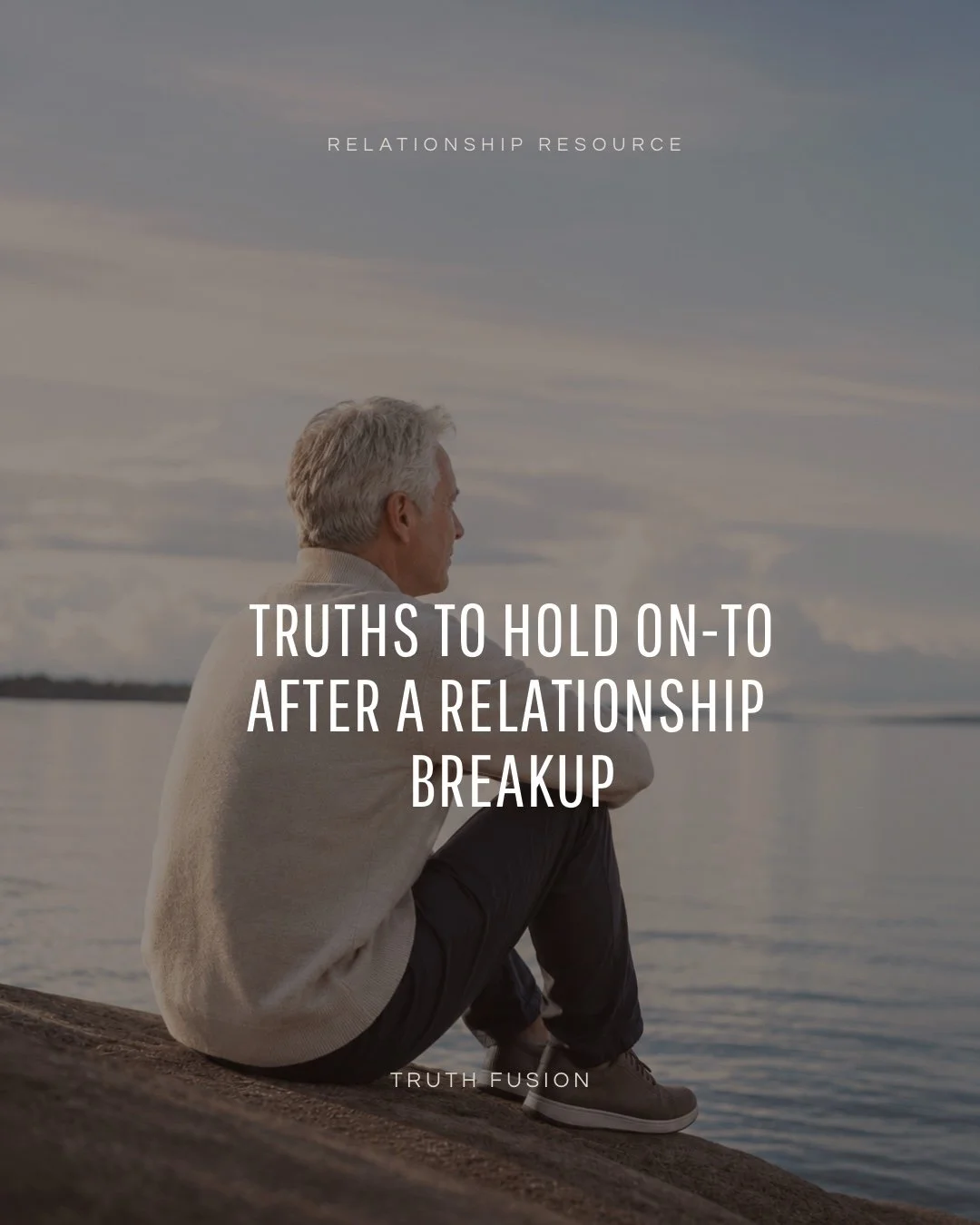
We created a free one-page resource, Truths to Hold Onto After a Relationship Ends, with Scripture, research-informed affirmations, and simple reflection prompts to help you steady your heart when grief feels overwhelming.
Download the free resource here
And if you feel like you need someone to help you process what happened, recognize unhealthy patterns, or begin healing with wisdom and support, we invite you to schedule a free consultation.
You do not have to carry this alone.
Join the Community
Together, we can bring healing and hope to individuals and communities, restoring lives, renewing minds, and shining light into the darkest places.
Sign up for our Newsletter and be the first to learn about new initiatives by Truth Fusion and how you can become part of this life-changing mission.
